Industry
- Automotive
What We Did
- 3D Scanning
- Reverse Engineering
- Exporting data: STL to STEP
Project Details
-
Fan Impeller & Scroll Assembly
Reconstructing a Flow-Driven System -
3D Scanning Accuracy: ± 0.05 mm
Final CAD Accuracy: ± 0.06 mm (Average). Local deviations may vary depending on geometry and feature accessibility
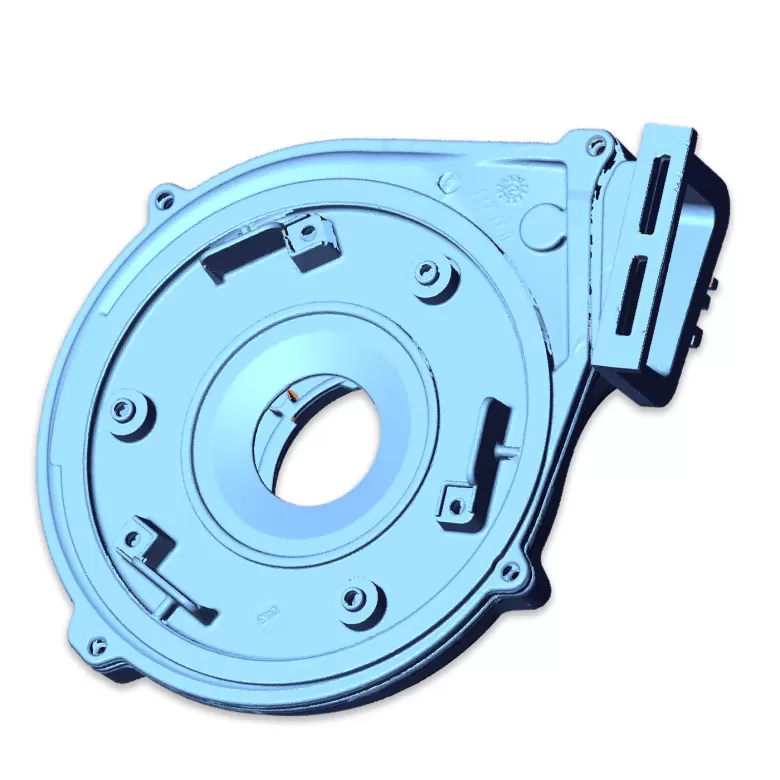

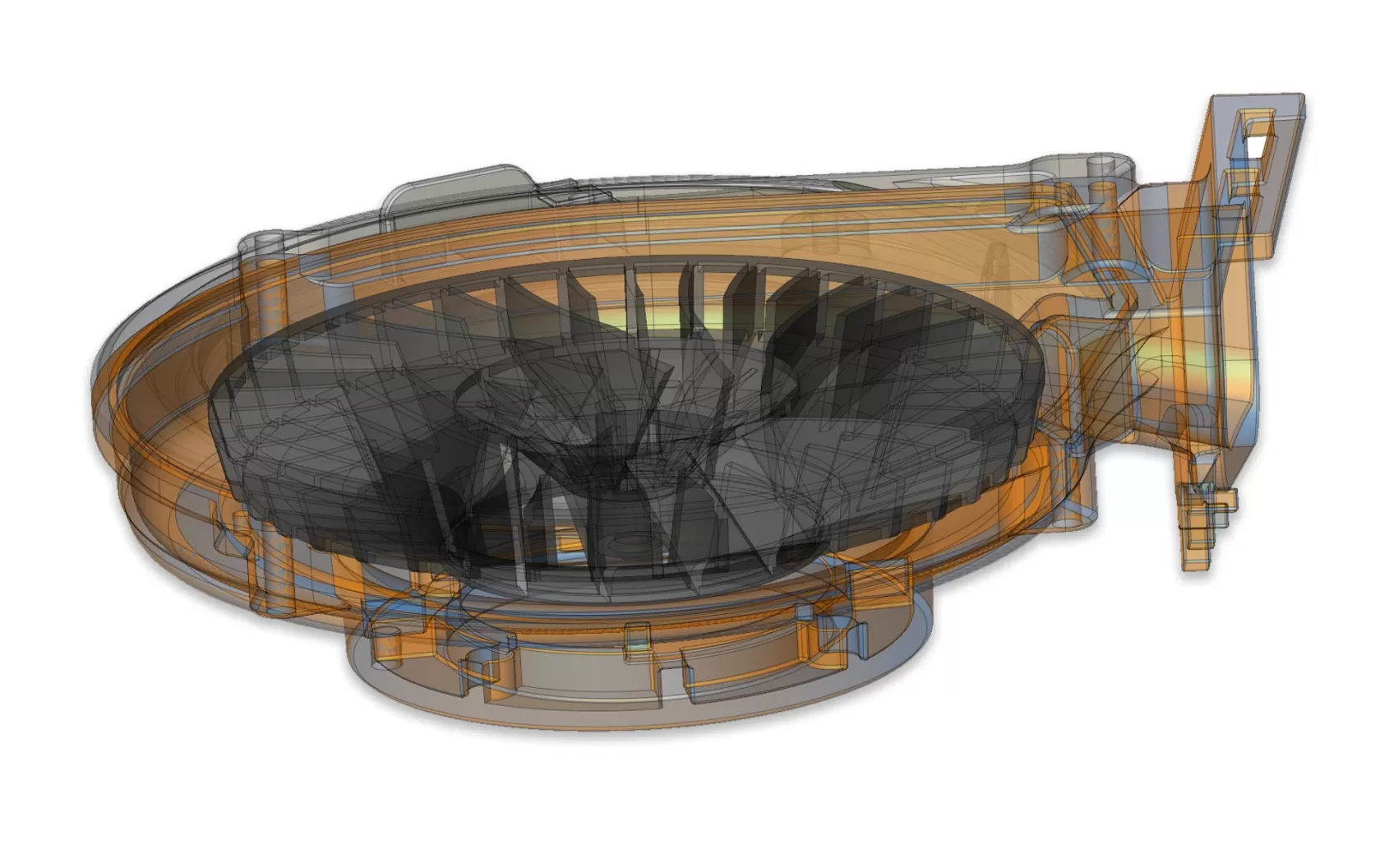
This project focuses on the reverse engineering of a centrifugal fan assembly used within a gas and air mixing system of a boiler. The objective is the reconstruction of three independent, fully parametric CAD models, comprising the impeller and the internal geometries of the two scroll housing halves, starting from STL scan data.
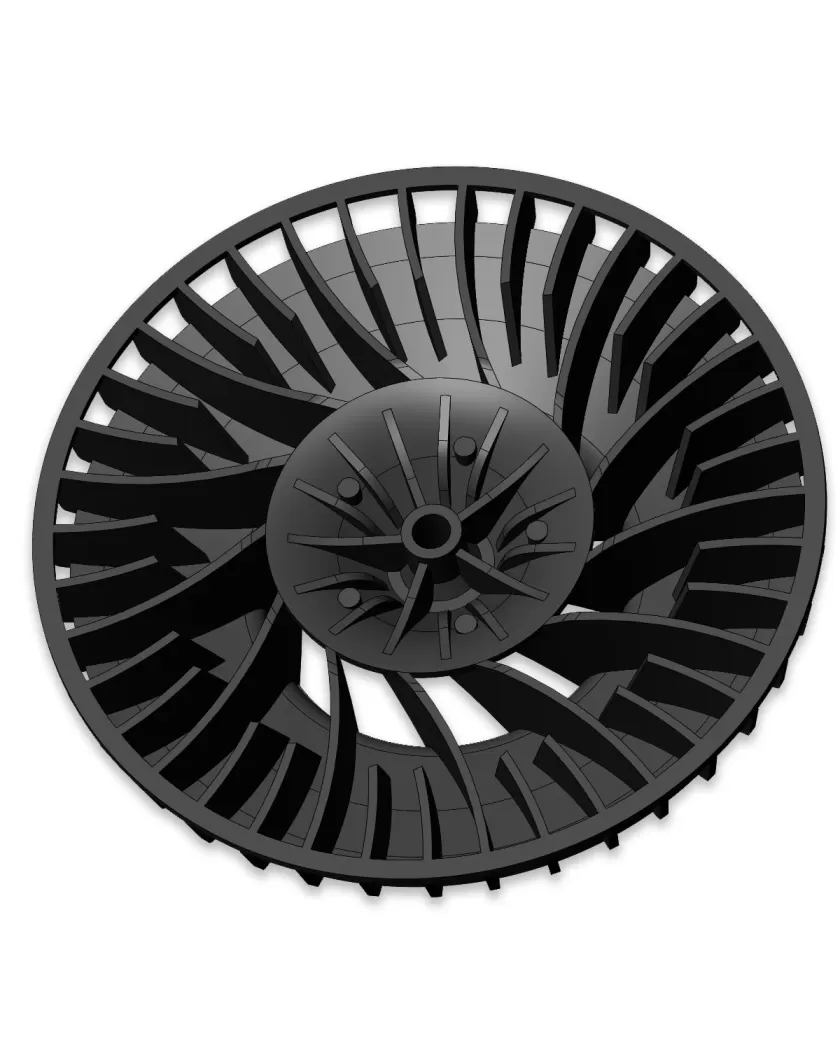
The input consists of multiple scan datasets acquired from individual components, including the impeller and both halves of the fan scroll. The reconstruction process is driven by the requirements of CFD simulation, where geometric consistency, continuity, and functional accuracy are prioritised over direct replication of scan data. The mesh is treated strictly as a geometric reference. Each component is analysed independently to identify critical flow paths, internal surfaces, and transitional regions affecting fluid behaviour. Particular attention is given to the internal scroll geometry, where surface continuity and section evolution directly influence pressure distribution and flow efficiency. The impeller is reconstructed based on rotational logic and pattern consistency. Rather than fitting each blade individually to the mesh, a controlled parametric definition is established, ensuring uniformity across the blade set and preserving aerodynamic coherence. The web structure and blade transitions are interpreted to maintain repeatability and structural clarity within the model. For the scroll housing, the reconstruction focuses on the internal flow volume. Non-relevant external features are deprioritised, while internal surfaces are rebuilt to ensure smooth transitions and stable curvature behaviour, critical for reliable CFD analysis. The separation of the two halves is maintained as independent parametric bodies, allowing flexible assembly and analysis configurations.
The final output consists of three clean, structured CAD models exported in STEP format: one impeller and two scroll housing halves. The geometry is optimised for simulation workflows, enabling accurate evaluation of fluid velocity, pressure drop, and mixing performance within the system.