Industry
- Automotive
What We Did
- 3D Scanning
- Reverse Engineering
- Exporting data: STL to STEP
Project Details
-
Exhaust Manifold
(Aluminium Casting)
-
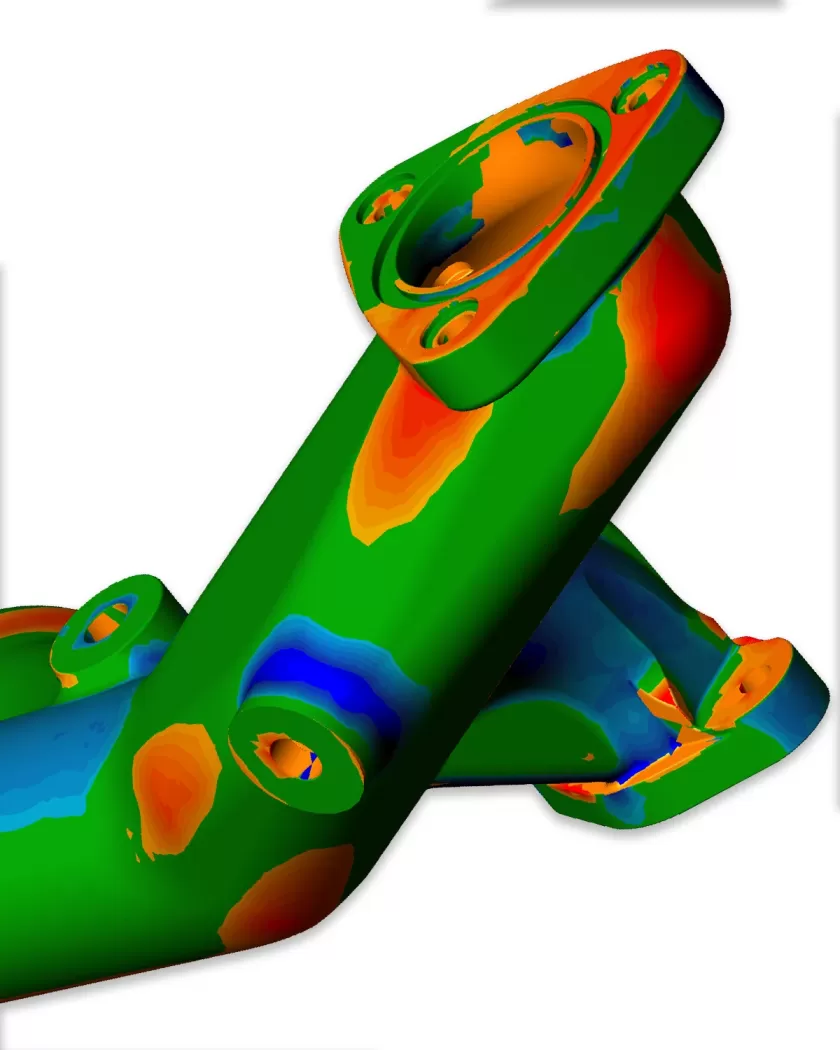
3D Scanning Accuracy: ± 0.035 mm
3D Scanning Accuracy: ± 0.035 mm Final CAD Accuracy: ± 0.15 mm (Average). Local deviations may vary depending on geometry and feature accessibility
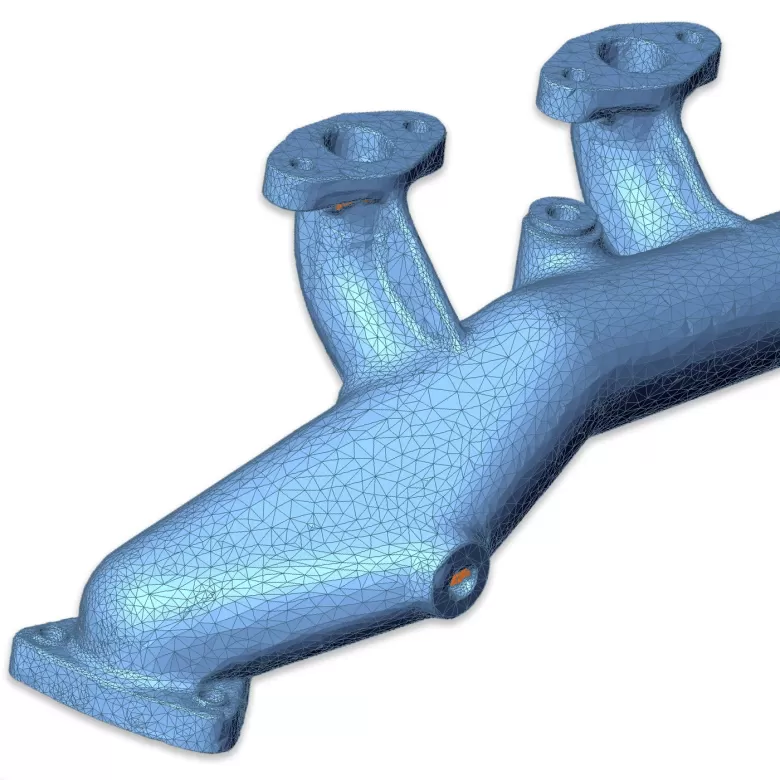

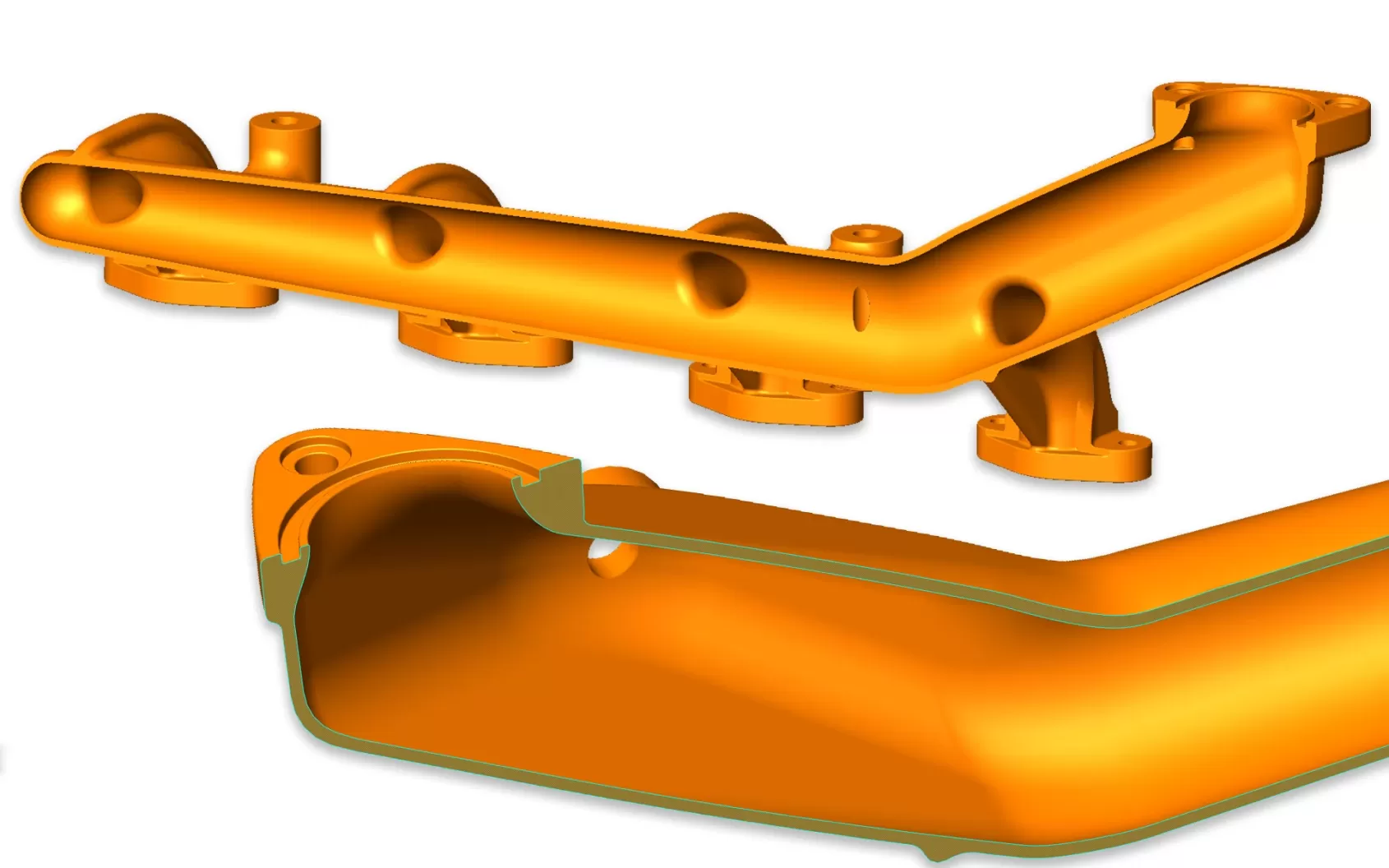
This project presents a practical example of reverse engineering applied to a cast aluminium exhaust manifold, starting from a 3D scan provided as an STL mesh. The objective is to demonstrate a clear and accessible workflow for converting triangulated scan data into a structured, fully parametric CAD model.
Unlike complex freeform reconstructions, this case focuses on a methodology based entirely on standard parametric features. The approach highlights how even irregular, organically shaped components, such as cast manifolds, can be interpreted and rebuilt using controlled geometry, without relying on advanced surfacing tools.
The STL scan acts as a geometric reference rather than a direct modelling input. Its purpose is to guide the reconstruction process, allowing key sections, axes and transitions to be identified and redefined through clean, editable features. This distinction is essential: the resulting CAD model is not a replica of the mesh, but a technically coherent interpretation of the original component.
The modelling strategy is built around a sequence of fundamental operations:
- 2D sketches are used to define primary cross-sections and reference profiles
- Extrusions establish the main volumetric structure
- Loft features handle transitions between varying geometries
- Revolutions are applied where axial symmetry is present
- Shell operations define internal thickness and wall consistency
Particular attention is given to maintaining geometric continuity across the manifold branches, ensuring that the flow paths remain consistent while simplifying irregularities introduced by the casting process. The result is a clean and editable model, suitable for downstream applications such as redesign, analysis or manufacturing. This project illustrates how reverse engineering is not merely a process of copying scan data, but a method of technical interpretation. By combining structured modelling techniques with informed geometric judgement, it is possible to transform raw scan information into a reliable and production-ready CAD definition.