Industry
- Biomedical
What We Did
- 3D Scanning
- Reverse Engineering
- Exporting data: STL to STEP
Project Details
-
Scan-Based Parametric Modelling of a Titanium Femoral Stem
-
3D Scanning Accuracy: ± 0.025 mm
Final CAD Accuracy: ± 0.06 mm (Average). Local deviations may vary depending on geometry and feature accessibility
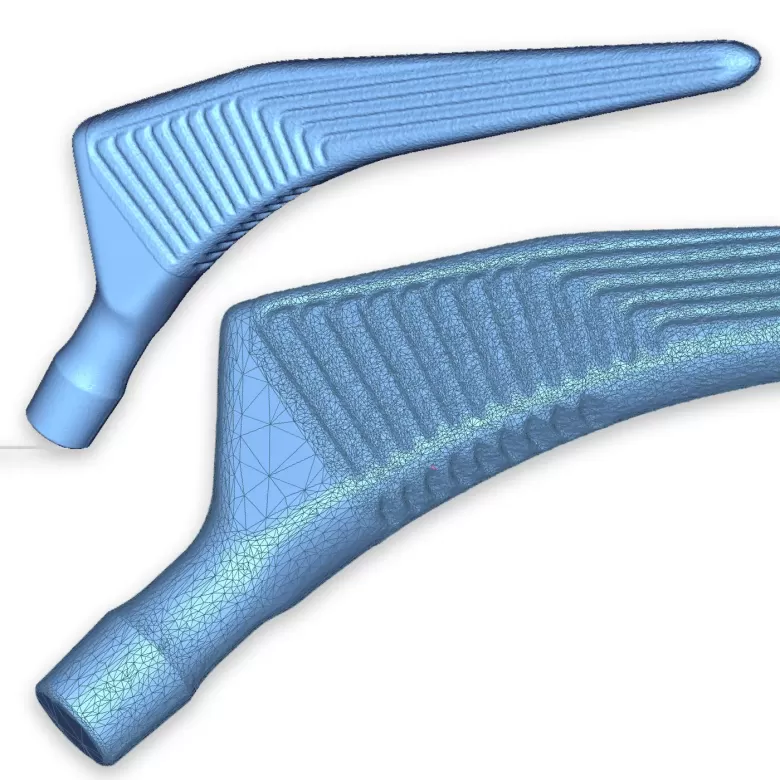

Titanium hip implants are widely used in orthopaedic surgery to restore joint function in patients affected by degenerative diseases such as osteoarthritis, trauma, or implant failure. The femoral stem plays a critical role in load transfer between the prosthetic joint and the femur, requiring a precise balance between mechanical strength, biocompatibility, and surface interaction with bone tissue.
The component presented here was digitally reconstructed starting from a physical titanium prosthesis. A high-resolution 3D scan was used as a geometric reference to capture the overall morphology and surface features of the implant, including its characteristic anatomical curvature and functional detailing. The CAD model was rebuilt through a fully parametric, feature-based approach. Rather than relying on direct mesh conversion, the geometry was interpreted and reconstructed using structured sketches and controlled features, ensuring clean topology, dimensional control, and design intent consistency. Particular attention was given to transitional surfaces, edge conditions, and repetitive micro-features, which are essential for both mechanical performance and manufacturability.
The resulting model is fully editable and adaptable within any standard CAD-CAM environment. The final geometry was exported in STEP format, enabling interoperability across platforms and supporting downstream applications such as toolpath generation, design validation, and potential customisation workflows. This approach ensures a robust digital representation of the implant, suitable for engineering analysis, manufacturing processes, and further development within regulated biomedical contexts.
We support biomedical 3D scanning and reverse engineering services for medical device applications requiring high precision and accuracy.