Industry
- Art & Heritage
What We Did
- 3D Scanning
- Reverse Engineering
- Exporting data: STL to STEP
Project Details
-
Brass Sculpture (Contemporary
Reconstructing Organic Forms in CAD -
3D Scanning Accuracy: ± 0.06 mm
Final CAD Accuracy: ± 0.1 mm (Average). Local deviations may vary depending on geometry and feature accessibility

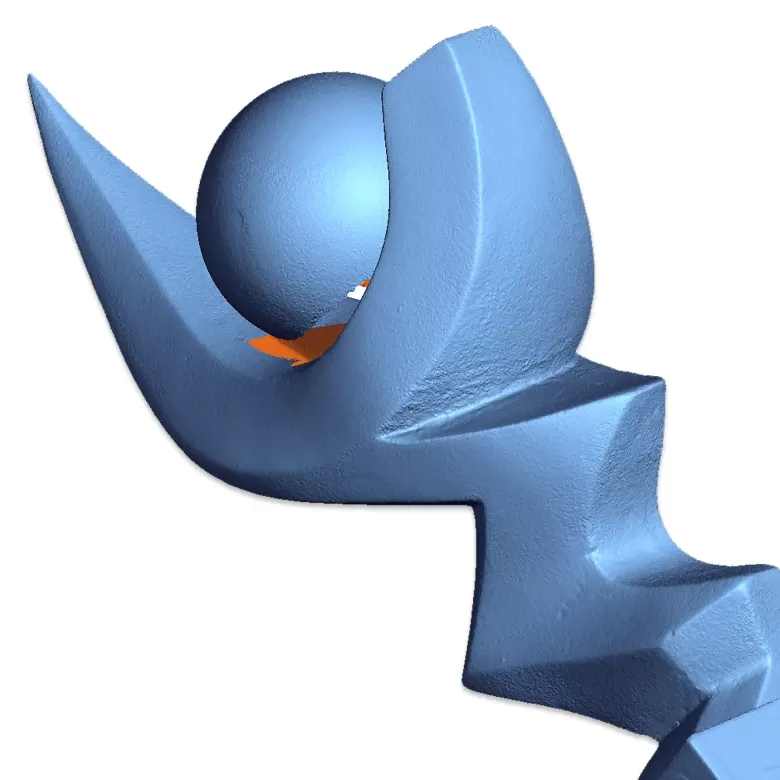
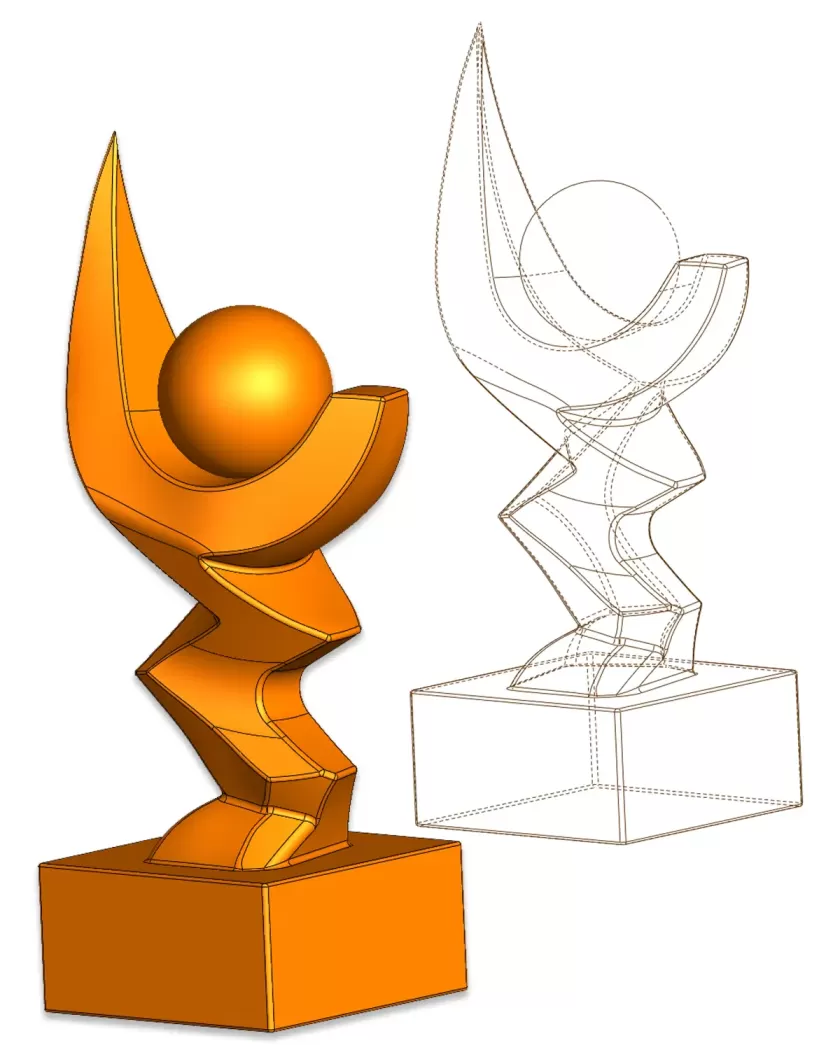
This project focused on the reverse engineering of a brass sculpture characterised by fluid, organic forms and continuous surface transitions. Unlike mechanical components, where geometry is typically defined by clear primitives and constraints, this type of object presents a different challenge: interpreting sculptural intent while maintaining geometric coherence.
Although automated workflows such as SubD modelling or Autosurfacing can accelerate the reconstruction of organic shapes, they often generate geometry that is difficult to control, edit or refine in a structured way. In this case, a deliberate decision was made to adopt a CAD-like modelling approach, prioritising control and long-term usability over speed The geometry was rebuilt through a structured surface modelling process, carefully defining curvature continuity and transitions between key regions of the sculpture. This method, while more time-intensive, ensures that the resulting model is not just a visual approximation, but a controlled and editable representation of the original form. One of the key advantages of this approach is the ability to introduce design refinements at any stage. Edge conditions can be adjusted, fillets can be applied consistently, and proportions can be tuned without compromising the integrity of the model. This is particularly valuable in creative and artistic contexts where iteration and variation are often required.
The final CAD model achieves a high level of surface quality and geometric consistency, significantly outperforming fast reconstruction methods that tend to produce fragmented or unstable geometry. The result is a production-ready digital asset that combines aesthetic fidelity with engineering robustness, suitable for further development, modification or manufacturing.
Key aspects:
- Reconstruction of complex organic geometry
- CAD-like surface modelling for full control and editability
- Avoidance of SubD/autosurfacing limitations
- High-quality surface continuity and refinement
- Flexible model ready for iteration and production