Industry
- Automotive
What We Did
- Reverse Engineering
- Exporting data: STEP
Project Details
-
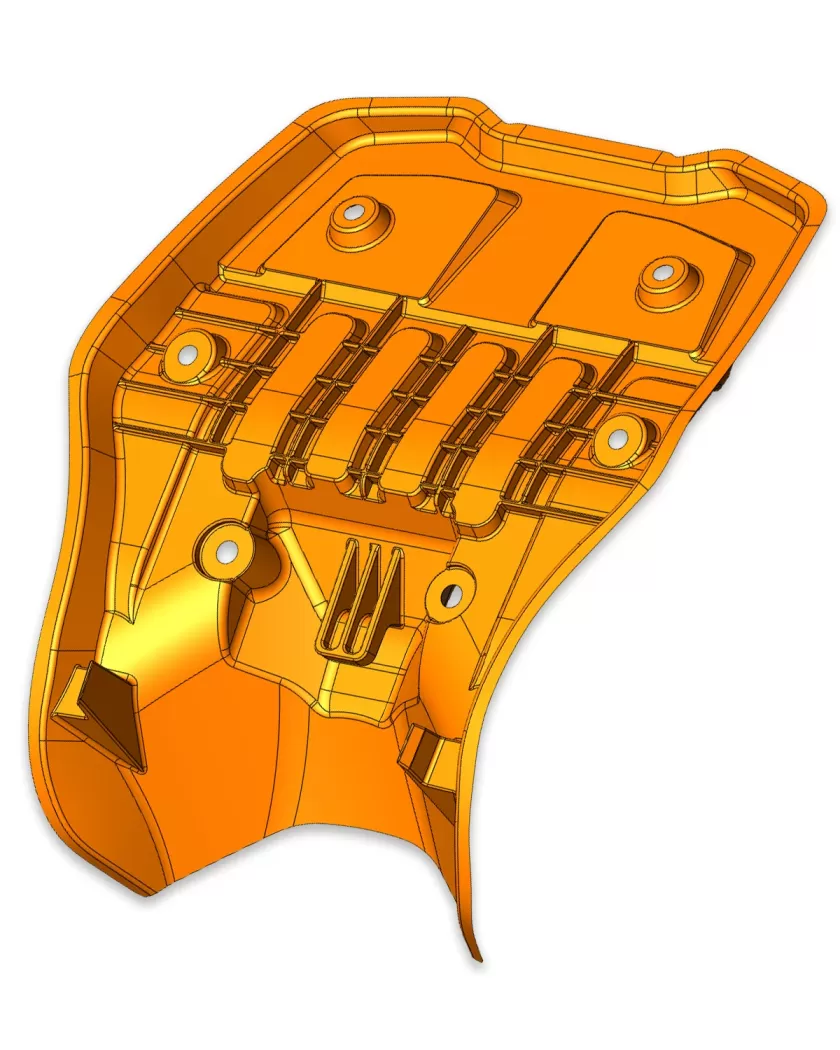
Motorcycle Seat
Reconstructing a Scan-Based Geometry -
3D Scanning Accuracy: Scan data provided by the client, with sufficient resolution for reconstruction purposes
Final CAD Accuracy: ± 0.1 mm (Average). Local deviations may vary depending on geometry and feature accessibility
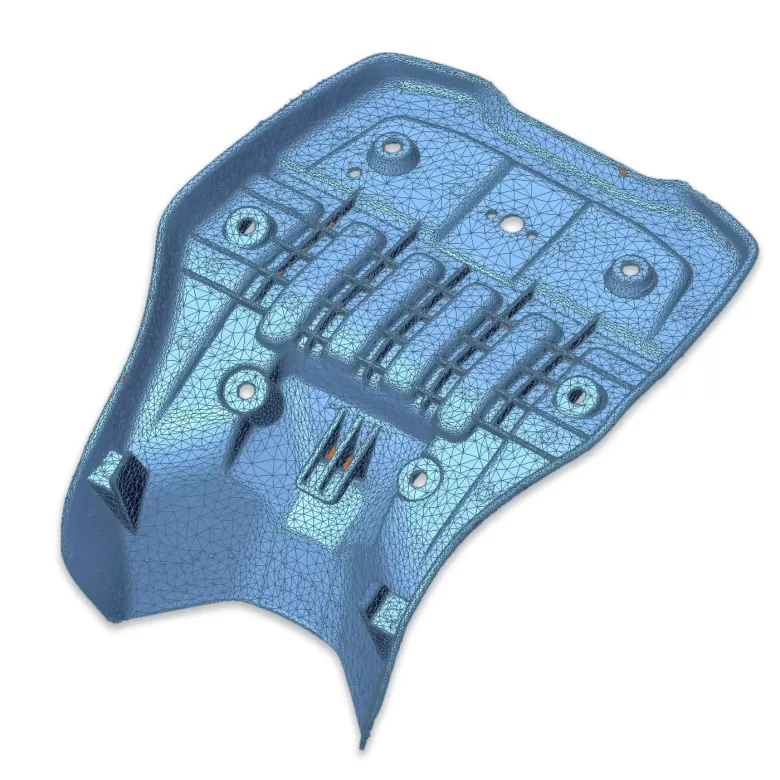

This project focuses on the reverse engineering of a plastic motorcycle seat, starting from high-resolution STL scan data and progressing toward a fully parametric CAD model suitable for engineering applications. The initial dataset consists of a dense triangular mesh acquired through 3D scanning. The mesh is used strictly as a geometric reference, not as direct modelling input. Particular attention is given to data quality, local noise, and irregular triangulation, which are evaluated and filtered before any reconstruction activity.
The reconstruction process follows a hybrid modelling approach, combining feature recognition with controlled surface rebuilding. Primary geometries are identified where possible, while freeform regions are interpreted through curve extraction and surface generation strategies aimed at ensuring geometric stability rather than local adherence to the mesh.
Curve networks are constructed to define the structural logic of the component, enabling consistent surface transitions and continuity control. Surface patches are then generated and refined to achieve a balance between fidelity to the reference data and manufacturability requirements. The final stage involves the generation of a fully constrained parametric solid model. The resulting geometry is clean, editable, and suitable for downstream applications such as redesign, tooling, inspection, or production.